Generative AI is rapidly moving beyond the cloud and into enterprise operations.
As companies take AI from proof-of-concept projects into knowledge management, production analytics, equipment maintenance, and eventually AI Agents capable of executing tasks, a new set of questions is emerging:
Is the data ready—and can the infrastructure keep up? If the servers are ready, are the enterprise data and applications ready as well?
In 2026, these questions have become increasingly urgent.
Demand for AI servers, HBM, and Server DRAM continues to rise. As a result, enterprise AI competition is gradually shifting from simply adopting models to determining how quickly organizations can prepare data, computing infrastructure, governance, and applications together.
The Real AI Bottleneck Is Often Not the Model
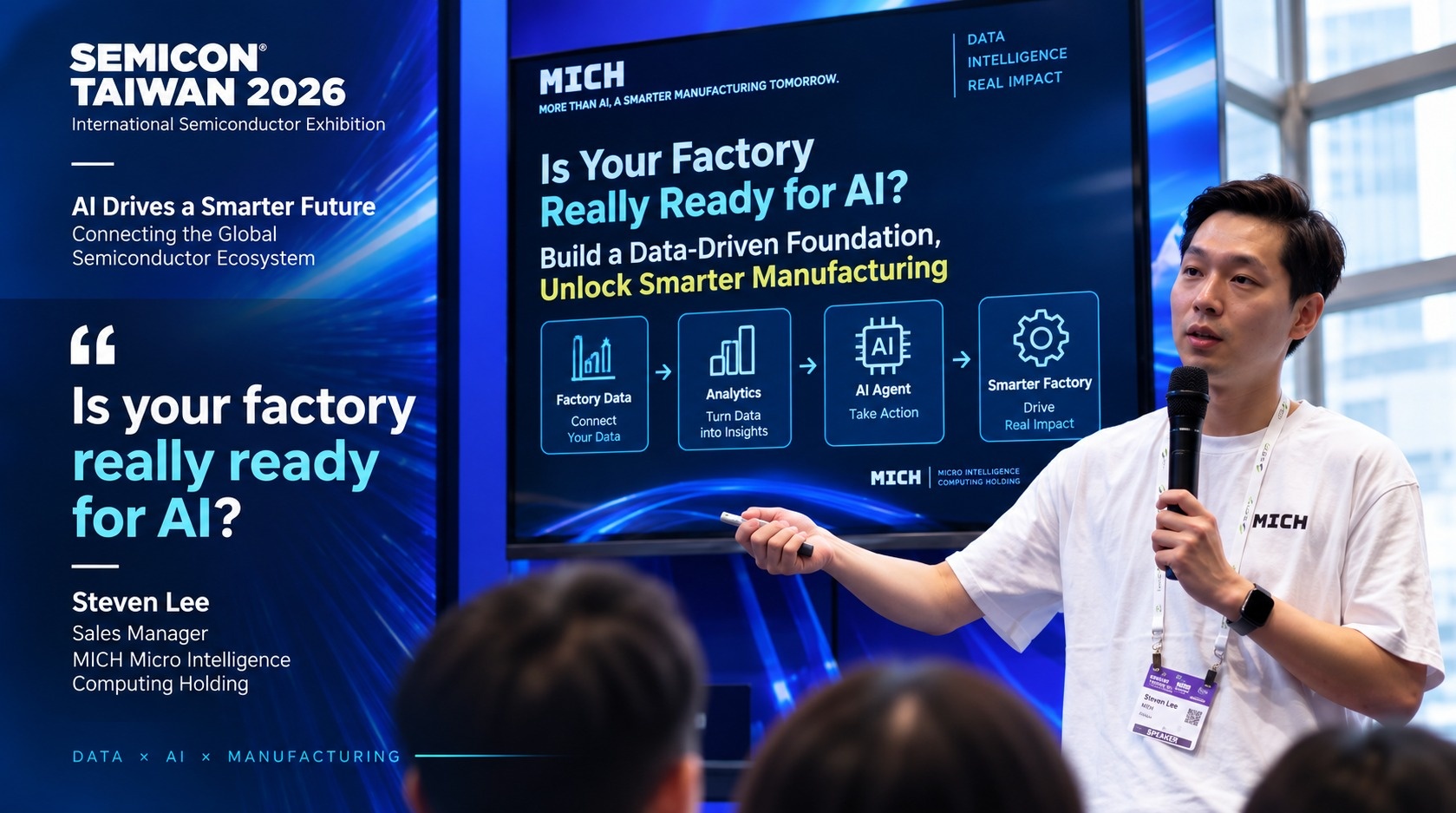
As Sales Manager at MICH Micro Intelligence Computing Holding, Steven Lee works closely with manufacturing companies on AI adoption and AI server sizing.
From his experience, one of the most common barriers to enterprise AI has little to do with whether a model has enough parameters.
The bigger challenge is that many organizations are simply not yet ready to let AI use their own data.
Manufacturing data may be distributed across ERP, MES, APS, WMS, PLCs, IIoT systems, SOPs, technical specifications, and the accumulated knowledge of experienced engineers.
Some of this information contains sensitive process knowledge that cannot leave the enterprise environment. At the same time, production applications often require low latency, reliability, and continuous availability.
This means enterprise AI cannot simply be treated as “adding another model” to the existing IT environment.
Instead, companies need to rethink how enterprise data, AI computing infrastructure, and applications connect with one another.
That does not mean every dataset must be perfectly organized before an AI project can begin.
Organizations with well-established SOPs and technical documents can start with RAG and enterprise knowledge applications. Factories with mature ERP and MES data can begin with production analytics and anomaly analysis. Companies with extensive equipment, sensor, or image data may begin by connecting shop-floor data.
What matters is that each deployment leaves behind a reusable foundation for the next AI application.
In 2026, Data and Compute Must Be Planned Together
Unlike several years ago, enterprises can no longer focus only on the software side of AI.
As inference workloads and Agent-based applications expand, demand for high-capacity Server DRAM, HBM, and AI servers continues to increase.
For companies already planning to deploy on-premises AI within the next six to twelve months, server sizing and procurement should not wait until every software requirement has been finalized.
However, Steven emphasizes that planning compute capacity early does not mean purchasing the most powerful GPU server available.
The better approach is the opposite:
Define the workload first. Then determine the infrastructure.
Will the company run RAG applications, LLM inference, computer vision models, or multiple AI Agents?
How many concurrent users will the system support? What are the expected model sizes, context lengths, concurrency levels, and response-time requirements? How many additional AI applications may be introduced over the next few years?
These factors collectively determine requirements for GPU VRAM, system memory, storage, networking, power, and cooling.
This becomes even more important as enterprise AI evolves from a single chatbot into an Agent ecosystem.
A single environment may eventually need to run embedding models, rerankers, LLMs, vector databases, and multiple supporting services simultaneously.
That is why AI server sizing is not simply a hardware procurement exercise—it is part of AI architecture design.
An undersized system may reach its limits soon after the first applications go live. An oversized system, on the other hand, may leave expensive GPU resources underutilized.
The goal is not to buy the largest server possible. It is to align infrastructure investment with the company’s actual AI roadmap.
Becoming AI-Ready Means Running Two Timelines in Parallel
This shift also introduces a different way of managing enterprise AI projects in 2026.
On the software side, the roadmap looks like this:
Data Assessment → Integration → Governance → AI Agents
On the infrastructure side:
Workload Definition → Sizing → Procurement → Deployment → Expansion
These two timelines need to move forward in parallel.
If the AI server arrives in the data center before the data and use cases are ready, expensive computing resources may sit idle.
But if the company completes its Agent design, data integration, and application planning before considering hardware, server lead times and availability may delay the entire deployment.
For Steven, this is one of the key changes enterprises need to recognize:
AI infrastructure can no longer be managed as two completely separate software and hardware procurement projects.
The two are increasingly part of the same architecture.
LowsiteOS Brings Data, Servers, and Agents Into One Architecture
Once data and computing resources are being prepared in parallel, the next challenge is enabling AI to operate within the factory.
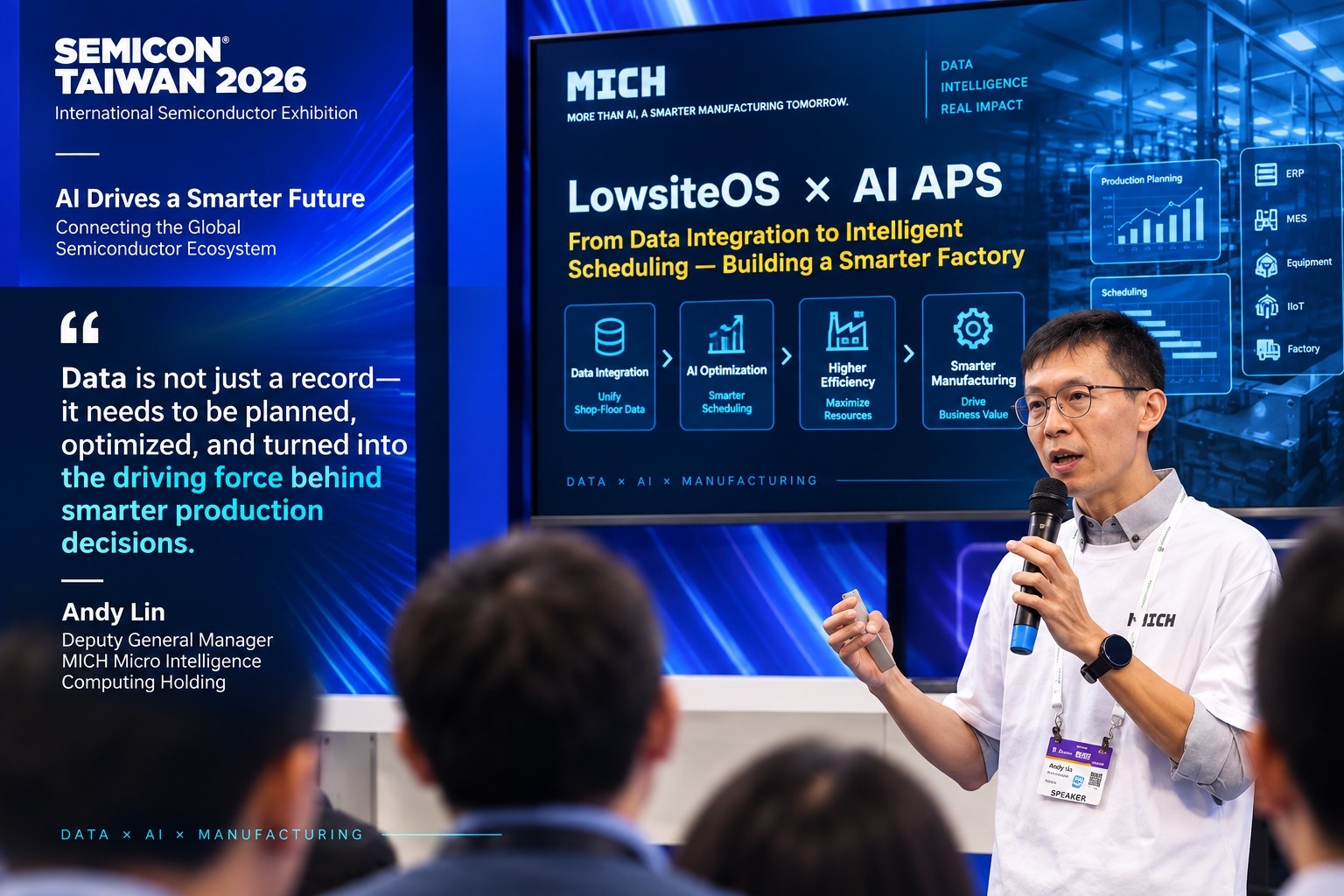
LowsiteOS is designed to turn existing ERP, MES, equipment, and enterprise knowledge into a shared data foundation for AI.
That foundation can then be combined with on-premises AI servers and models, allowing multiple Agents to operate on a common data and governance architecture.
The overall stack can be represented as:
Enterprise Data → LowsiteOS Data Layer → On-Premises AI Server / Models → AI Agents → ERP / MES / Shop-Floor Applications
With this architecture, enterprises do not need to rebuild their data and computing environments every time a new Agent is introduced.
The foundation created for the first Agent can support the second and third applications. As workloads increase, server capacity can then be expanded according to actual demand.
Governance must scale alongside those capabilities.
AI should not become a “superuser” simply because it can access enterprise data. Permissions should evolve gradually—from querying and analyzing information to making recommendations and, eventually, writing information back to ERP or MES.
Actions affecting core enterprise systems should be governed by appropriate permissions and human approval mechanisms.
In practical terms:
Compute determines whether AI can run. Data determines whether AI has something meaningful to understand. Governance determines whether the enterprise can trust AI enough to use it.
In the AI Era, the Real Race Is Readiness
As AI continues moving from hyperscale cloud data centers toward enterprises, factories, and edge environments, manufacturers are facing a different question.
It is no longer simply:
“Should we adopt AI?”
The more important question is:
“Can we get ready fast enough?”
A truly AI-ready factory is not defined by having another GPU server in the data center. Nor is it defined simply by having digitized ERP and MES systems.
It requires usable data, available computing capacity, controlled access, and clearly defined use cases for AI Agents.
In a market where AI infrastructure remains under pressure, the most valuable advantage may not be securing GPUs alone.
It may be the ability to prepare data, servers, governance, and AI applications at the same time—and faster than the competition.
That is where the next stage of smart manufacturing begins.