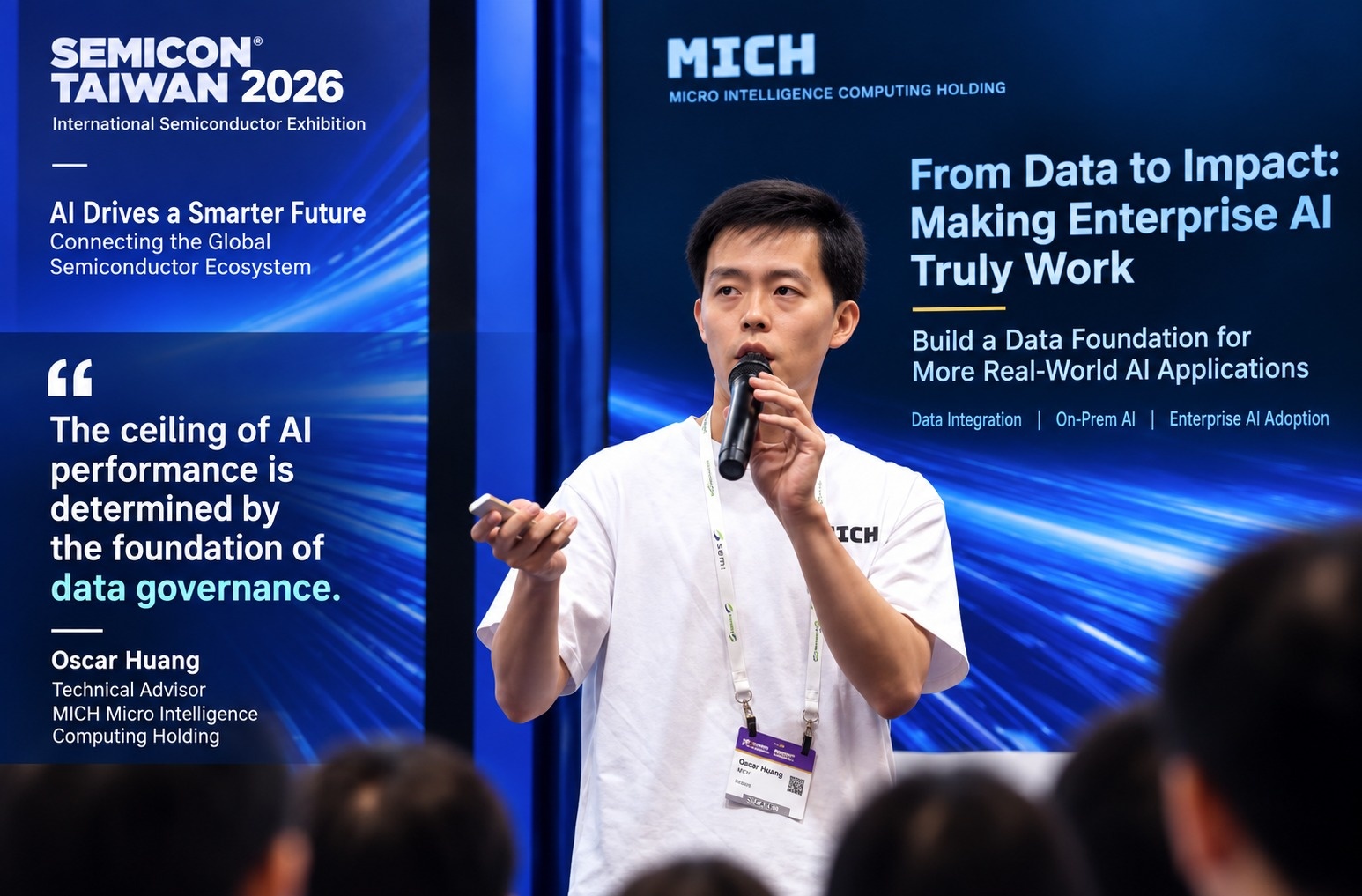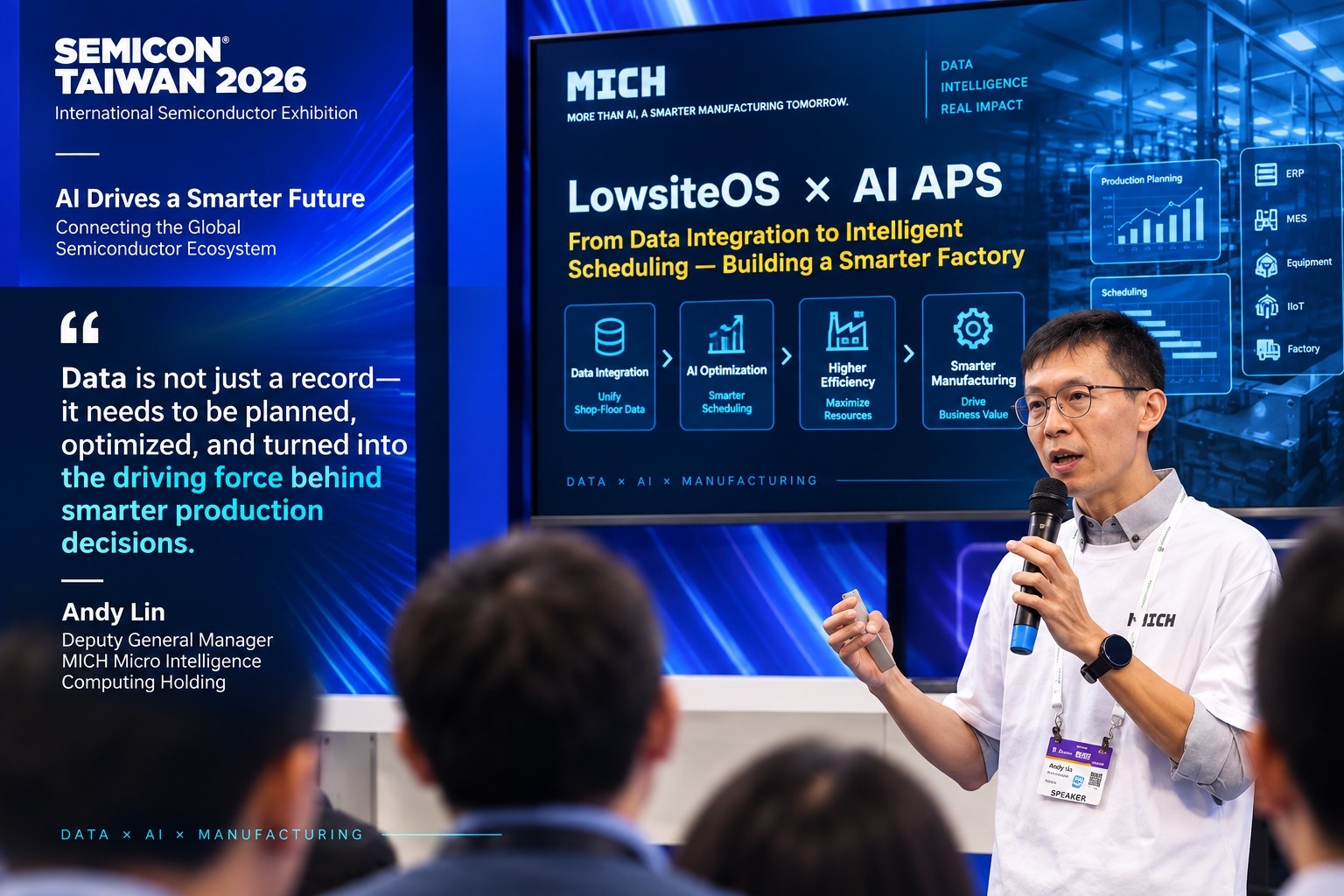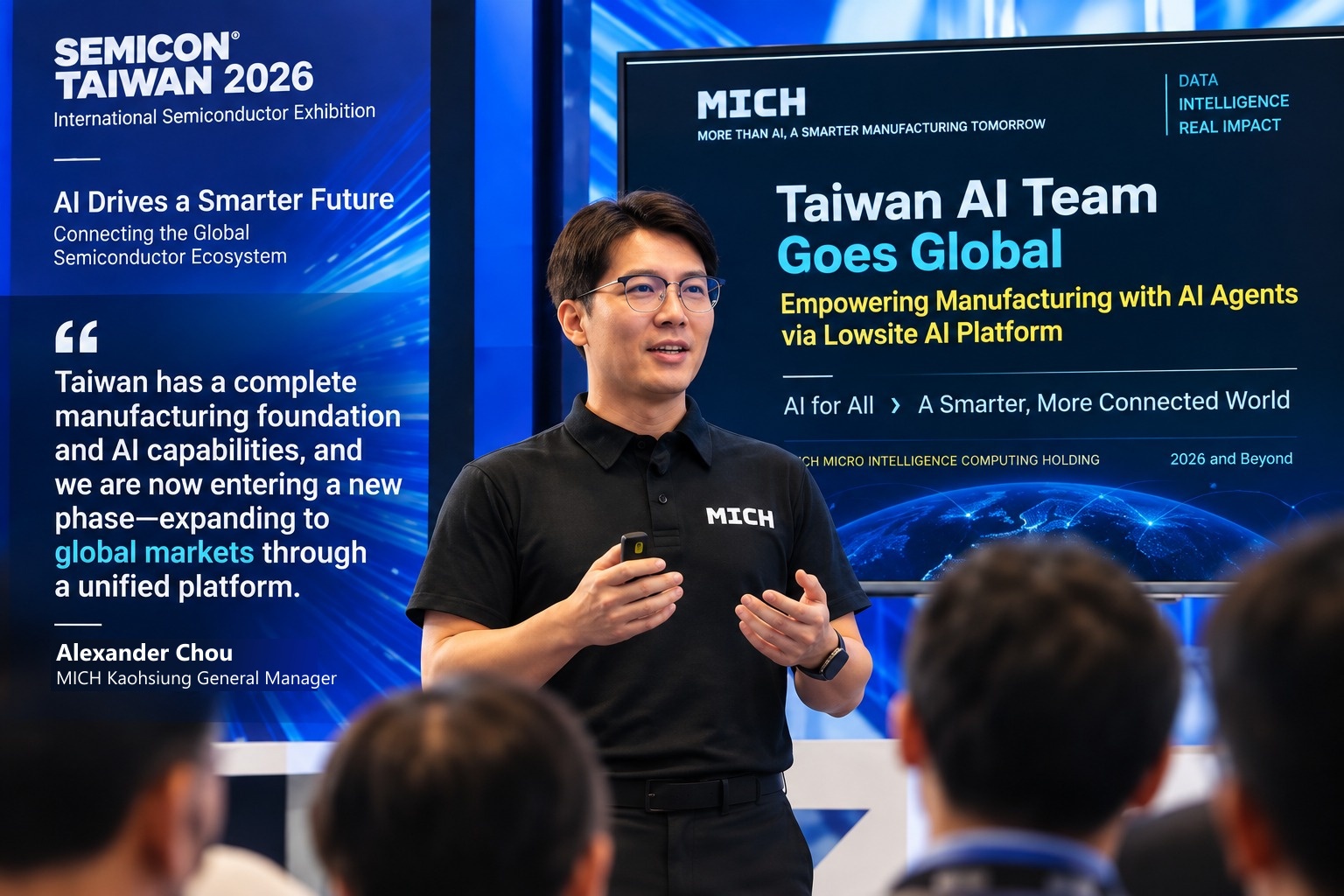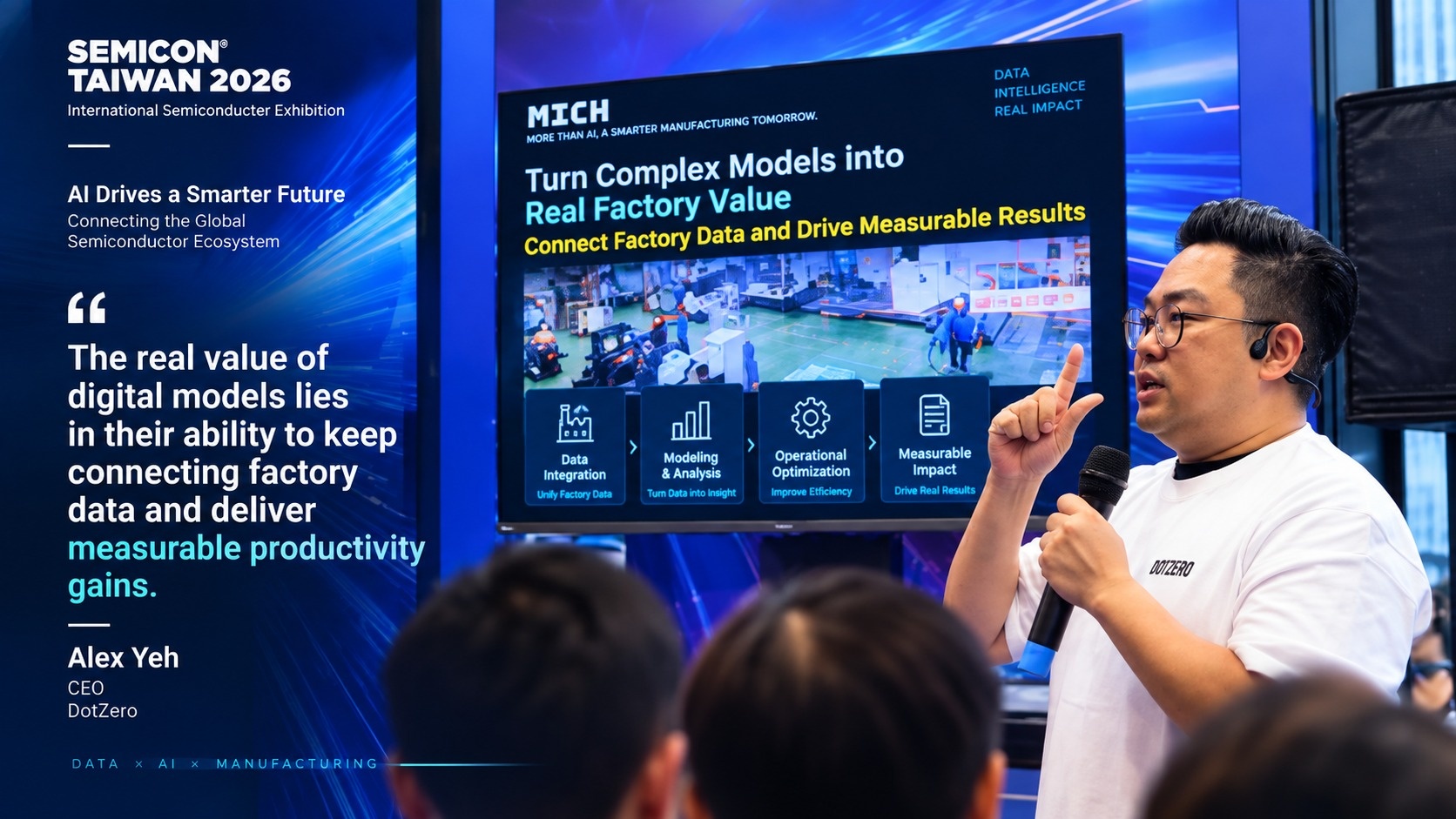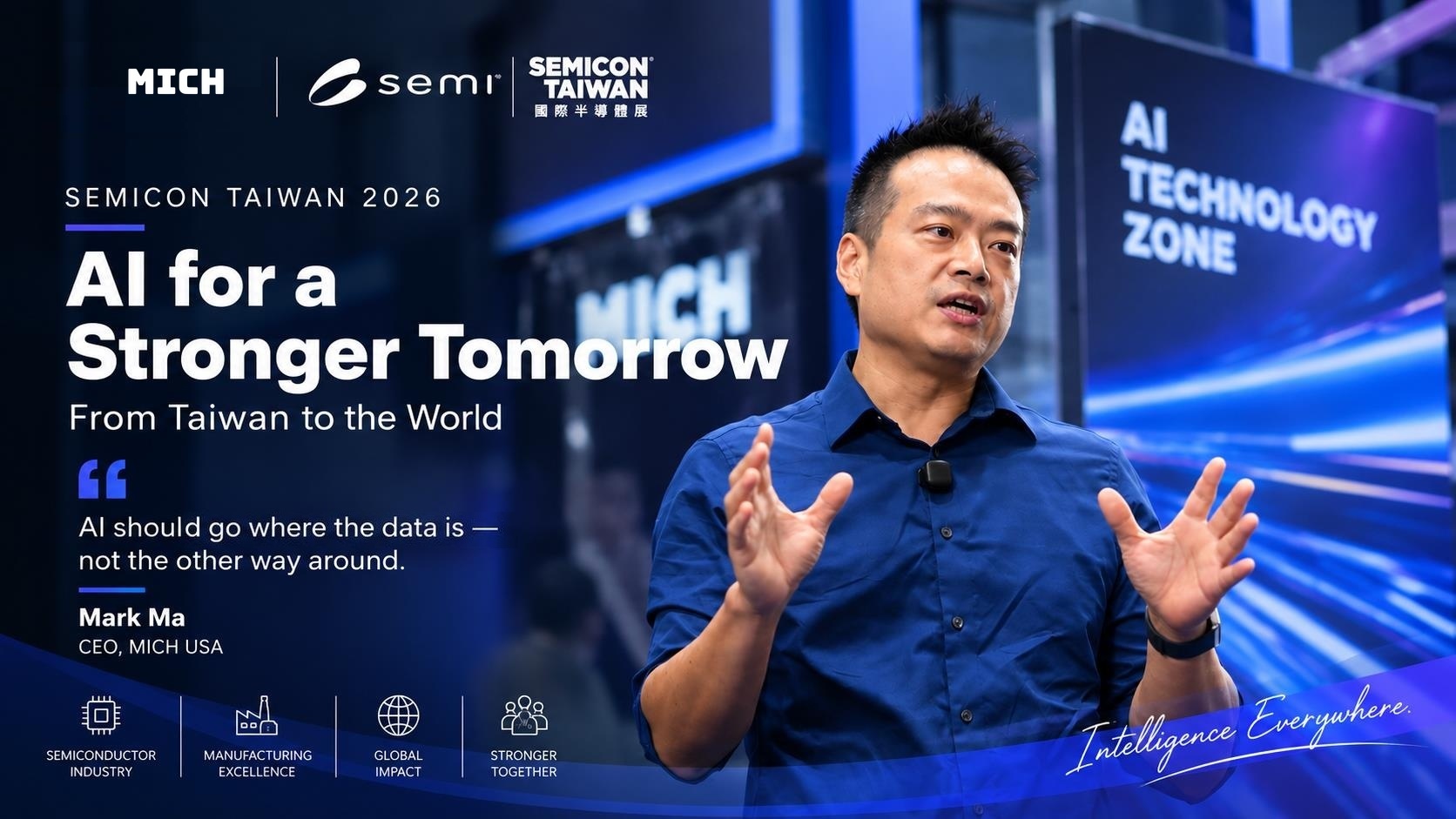
During SEMICON Taiwan 2026, MICH USA CEO Mark Ma sat down for an interview to share MICH's perspective on enterprise AI and Taiwan's next step toward international markets.
One point stood out above the rest:
AI should go where the data is — not the other way around.
That question is at the core of what MICH is building with LowsiteOS, our enterprise AI infrastructure.
The next stage of AI is actually getting into the enterprise
Over the past few years, generative AI and large language models have advanced quickly, and companies have started exploring how to bring AI into customer service, knowledge management, operational analysis, and even production and decision-making.
But moving from a demo to real enterprise AI changes the question entirely. What companies actually need to solve is: how does AI get access to the enterprise's own data?
Manufacturers generate enormous amounts of information every day — from ERP, MES, SCM, and WMS to equipment, production, quality, and documents. The data already exists. The problem is that it's scattered across different systems, machines, and formats. If AI can't understand that data, it can't really understand how a company operates.
So the next round of AI competition isn't just about "which model" — it's about whether a company can build the foundation that lets AI safely access, understand, and use its data.
AI should go where the data is
For many companies — especially in semiconductors, manufacturing, and high tech — data isn't just information; it's a core strategic asset. Production parameters, equipment data, process know-how, quality records, customer information, and internal documents can all be highly sensitive operational information.
So as companies adopt AI, whether data should ever leave the enterprise's own environment becomes a real question. That's one of the reasons MICH emphasizes on-prem AI.
Rather than asking companies to move sensitive data out to a different environment just to use AI, we'd rather bring AI into the data environment a company already has. Let AI move toward the data, instead of making the data chase AI. That way, companies can keep control over their data, permissions, and infrastructure even as they build out AI applications.
LowsiteOS: building enterprise AI by starting with data integration
That's the core direction behind LowsiteOS. Companies already run on a large stack of existing systems, so adopting AI shouldn't mean starting from scratch. LowsiteOS is built to be the infrastructure that connects a company's existing data with its AI applications.
From ERP, MES, SCM, and WMS to equipment, production data, and internal enterprise knowledge — data integration gradually builds an enterprise data environment that AI can actually understand and use. The whole process can be summarized as:
Data Integration → Enterprise Knowledge → AI Applications
From connecting the data, to AI understanding enterprise knowledge, to finally powering real AI Agents and enterprise applications — this is what lets AI stop being just an isolated chat tool and start actually entering a company's existing workflows.
From Taiwan's factory floors to the US enterprise market
For Mark and the MICH USA team, returning to Taiwan for SEMICON Taiwan also represents another important direction: how to bring Taiwan's accumulated strength in AI and manufacturing to a bigger, global market.
Taiwan has a complete semiconductor and manufacturing supply chain, along with deep experience in hardware-software integration, equipment, edge AI, and industry applications. As companies worldwide look for AI solutions that can actually be deployed, Taiwan's advantage isn't necessarily a single product — it's the opportunity to integrate different technologies into one complete enterprise AI solution.
That's why MICH's next role isn't just being an AI technology provider. We want LowsiteOS to serve as the data and infrastructure layer for enterprise AI, connecting Taiwan's different AI Agents, software, hardware, and industry solutions — moving from a single technology to a complete solution, and from Taiwan to the US and the world.
Taiwan AI's next opportunity is going global together
SEMICON Taiwan is one of the world's most important platforms for the semiconductor industry. But for MICH, exhibiting here wasn't just about showing one product. More importantly, we saw technologies, solutions, and industry partners from many different fields on the floor — capabilities that, if connected more effectively, could form a more complete AI ecosystem.
Keep the data inside the enterprise, bring AI onto the floor — and let Taiwan's strongest AI technology go global together.
From Taiwan's factory floors to enterprises in the United States: we believe the next step for enterprise AI isn't just building a more powerful model. It's bringing AI genuinely into industry, to solve real-world problems.
From Taiwan to the World. Intelligence Everywhere.