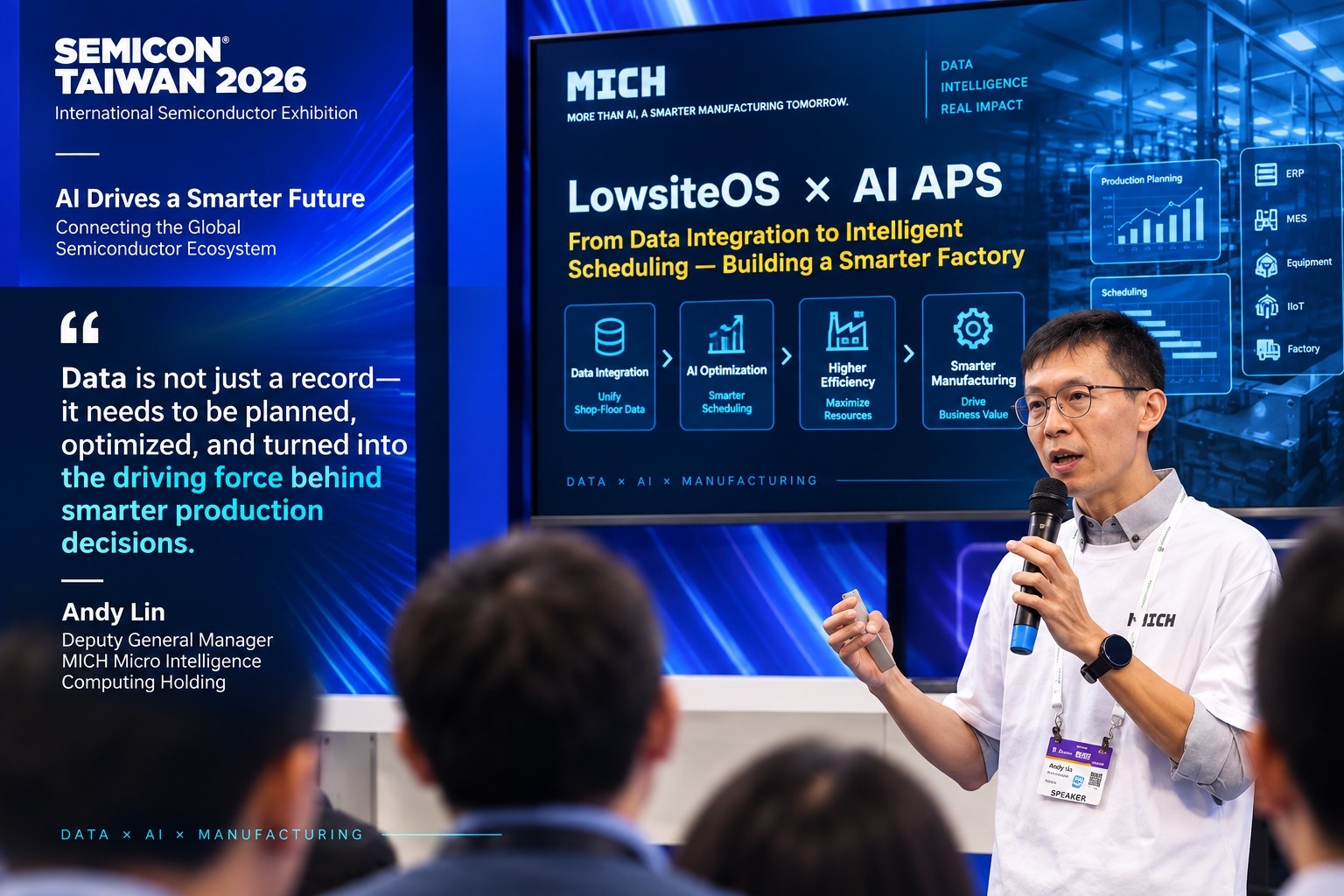
Manufacturers are accumulating more data than ever. But having data does not necessarily mean being able to make better decisions.
From ERP and MES to equipment and work-in-process (WIP) information, factories generate enormous volumes of data every day. Yet on the production floor, managers face a more immediate challenge: when a rush order arrives, equipment capacity changes, materials are delayed, or the original production plan is disrupted, can that data tell the enterprise what is likely to happen next—and how it should respond?
This is why APS (Advanced Planning and Scheduling) is evolving from a traditional scheduling tool into a “digital decision-making brain” for manufacturing.
Andy Lin, Senior Vice President of Yu Qing Digital Intelligence, believes that the next stage of smart manufacturing goes beyond digitalizing production information. The goal is to use that data for prediction and optimization.
Yu Qing’s u-APS builds capacity models based on order demand, machine configuration, capacity constraints, and historical production records. It predicts production cycle times and workload across workstations, then uses those insights to optimize material release, production planning, and bottleneck scheduling.
Creating a Production Schedule Does Not Mean the Scheduling Problem Is Solved
Factory scheduling has never been as simple as assigning orders to machines in sequence.
Real-world manufacturing involves multiple constraints at the same time: delivery deadlines, capacity, materials, equipment availability, process sequences, and bottleneck workstations.
When a rush order arrives, equipment fails, or order requirements change, the original production plan must adapt accordingly.
As high-mix, low-volume production and rush orders become increasingly common, traditional scheduling methods that rely heavily on human experience are becoming less capable of responding quickly to complex shop-floor changes.
As a result, the value of APS is expanding beyond scheduling efficiency toward intelligent decision-making.
One of the core capabilities of Yu Qing’s u-APS is a dynamic Cycle Time model that reflects actual production conditions.
Based on delivery requirements, capacity constraints, and current production status, the system can forecast delivery dates, assess on-time delivery performance, estimate machine-group loading, and generate daily production targets for individual workstations.
From “How Should We Schedule Today?” to “Can We Take This Order?”
As APS gains predictive and optimization capabilities, the questions managers can ask begin to change.
If a rush order arrives today, how will it affect the delivery dates of existing orders? Is there enough capacity to accept additional demand? Which machine group is likely to become the next bottleneck? Based on current WIP and material-release conditions, can the order still be completed on time?
Answering these questions requires more than a static production schedule.
Capacity, on-hand WIP, material release, and order information must be continuously evaluated within the same decision-making framework.
Yu Qing’s planning architecture uses this information to predict Cycle Time and further estimate delivery dates, on-time delivery performance, and Machine Loading.
This enables production management to move from rescheduling after problems occur toward predictive planning and scenario simulation before they happen.
For enterprises, this represents a fundamental change in the role of APS:
APS is no longer simply a production scheduling tool. It is becoming a decision-support system that helps managers evaluate capacity, delivery commitments, and production risks.
AI Does Not Replace Production Planners—It Evaluates More Possibilities for Them
Traditionally, the value of experienced production planners has come from years of accumulated shop-floor knowledge.
Which order should take priority? Which workstation is about to become congested? How should the schedule change after a rush order is inserted?
These decisions often depend on people who understand the production line deeply.
But as the number of orders, products, machines, and operational constraints continues to grow, it becomes increasingly difficult for one person to evaluate every possible scenario simultaneously.
The value of AI APS, therefore, is not simply to “automate” manual scheduling.
Instead, algorithms can rapidly evaluate different production conditions and scheduling scenarios, giving managers a broader set of possibilities from which to make informed decisions.
Yu Qing positions u-APS as an intelligent production planning solution that combines an optimization engine with machine learning to address planning and scheduling requirements under complex, multi-constraint manufacturing environments.
For APS to Become Smarter, the Data Must Be Connected First
Even the most advanced predictive models and scheduling algorithms share one fundamental requirement:
They need access to usable data.
Predicting delivery dates, Cycle Time, and machine loading requires APS to combine information from ERP, MES, WIP, capacity, materials, and other sources.
Yu Qing’s architecture similarly draws production-related information from ERP, MES, Excel, material management systems, and other enterprise data sources.
The challenge is that many manufacturers do not lack data.
Their data is simply scattered across different systems, databases, tables, and departments.
When data formats, field definitions, and sources are fragmented, the first challenge in implementing intelligent scheduling is often not whether the algorithm is powerful enough, but:
How can APS continuously access accurate, complete, and usable enterprise data?
This is why data integration and intelligent scheduling should be viewed as two connected stages of the same AI transformation journey.
LowsiteOS × AI APS: From Data Integration to Production Decision-Making
This is where MICH’s LowsiteOS and Yu Qing’s AI APS complement each other.
LowsiteOS addresses the data foundation required before AI applications can operate effectively. It connects and integrates information that was previously distributed across different enterprise systems.
APS then uses that manufacturing data for production planning, delivery forecasting, and scheduling optimization.
The two address different layers of smart manufacturing:
LowsiteOS gets the data ready. APS puts the data to work in decision-making.
From an architectural perspective, LowsiteOS does not replace ERP, MES, or APS.
Instead, it creates a common data foundation across these systems that can support downstream AI applications. When APS operates on top of this environment, it can transform underlying production data into actionable insights related to capacity, delivery commitments, and scheduling.
This also means that implementing APS does not have to create another isolated data silo.
As enterprises later introduce quality analytics, predictive maintenance, knowledge management, or other AI Agents, the same data foundation can continue supporting new applications.
Enterprise AI infrastructure can therefore evolve from one-off system integrations into a scalable architecture that supports continuous expansion.
The smart manufacturing journey becomes:
Data Integration → Production Forecasting → Scheduling Optimization → Decision Applications
LowsiteOS turns fragmented enterprise data into a foundation that AI can use. AI APS then transforms that data into decision-making capabilities that directly influence delivery performance, production capacity, and scheduling.
The Next Step for Smart Factories Is More Than “Seeing the Data”
Over the past decade, manufacturers have invested heavily in digitalization.
From ERP and MES to connected equipment, the focus has largely been on capturing shop-floor information and making it visible through digital systems.
But as data continues to accumulate, the next question is fundamentally different:
Now that enterprises have all this data, can they use it to make better decisions—earlier?
This is where the combination of AI APS and an enterprise data platform becomes particularly valuable.
The value of a smart factory should not simply be another dashboard for managers.
When the next rush order arrives, the enterprise should be able to quickly evaluate how it will affect capacity, delivery commitments, and existing orders. When a bottleneck is beginning to form, the organization should be able to anticipate its impact before it becomes a production problem.
By establishing the data foundation through LowsiteOS and using APS to transform that data into prediction and optimization capabilities, AI can move beyond being a tool for analyzing information and become part of the day-to-day production decision-making process.
The defining line for the next generation of smart manufacturing may no longer be whether a factory “has AI,” but whether AI can meaningfully participate in decision-making.