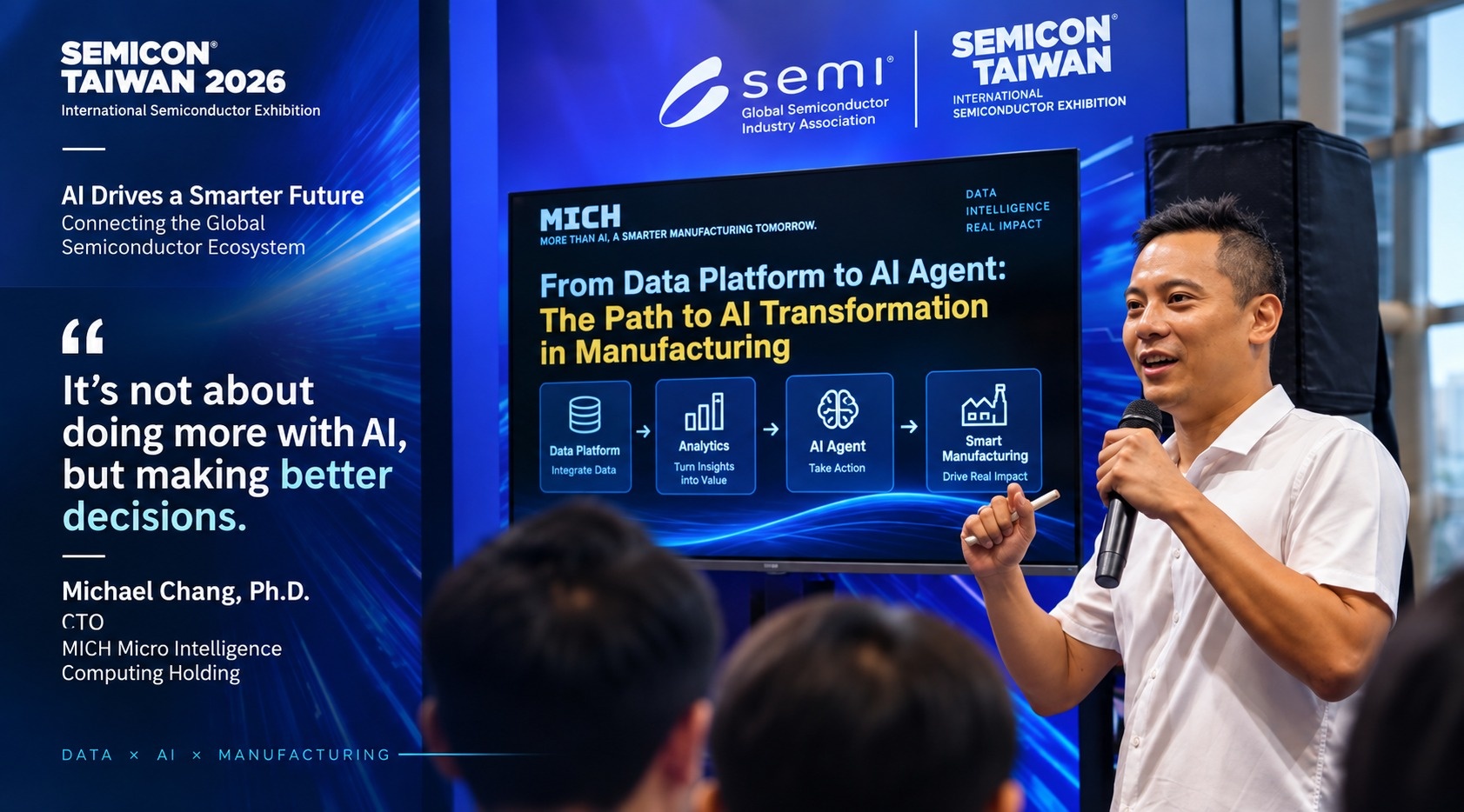
Michael Chang, Ph.D., Chief Technology Officer of MICH Micro Intelligence Computing Holding, has built his career across computer science, algorithms, artificial intelligence, and enterprise applications. His academic work has been published in a Nature portfolio journal, and he holds multiple patents related to algorithmic technologies. His experience spans research institutions, the technology industry, entrepreneurship, and business management, giving him a perspective that bridges technical innovation with real-world commercialization.
This background shapes how Michael Chang approaches enterprise AI. Rather than focusing solely on deploying more powerful models, he looks at a broader question:
How can data, algorithms, and AI agents become part of the enterprise decision-making process?
Before AI Agents Enter the Factory, They Need the Right Data
One of the most underestimated challenges in enterprise AI is not the model itself, but the data engineering required before inference can even begin.
Consider a new APS or AI agent that requires 18 data tables, while the company’s existing MES contains 50 tables and its ERP another 60.
The data may already exist, but the difficult questions remain: Which fields across those 110 source tables represent the correct source of truth? How should schemas across different systems be mapped? How should formats be transformed? And once integration is complete, how should the results be validated?
All of this happens before AI begins generating meaningful output.
Chang points out that if every new AI application requires enterprises to rebuild system integrations, reorganize data, and redefine fields from scratch, even a successful first PoC becomes difficult to replicate across a second or third use case.
The goal of enterprise AI transformation, therefore, is not to create more isolated projects. It is to move from “one requirement, one data pipeline” toward “multiple AI applications built on a shared data foundation.”
Moving Beyond Data Integration to AI-Ready Data
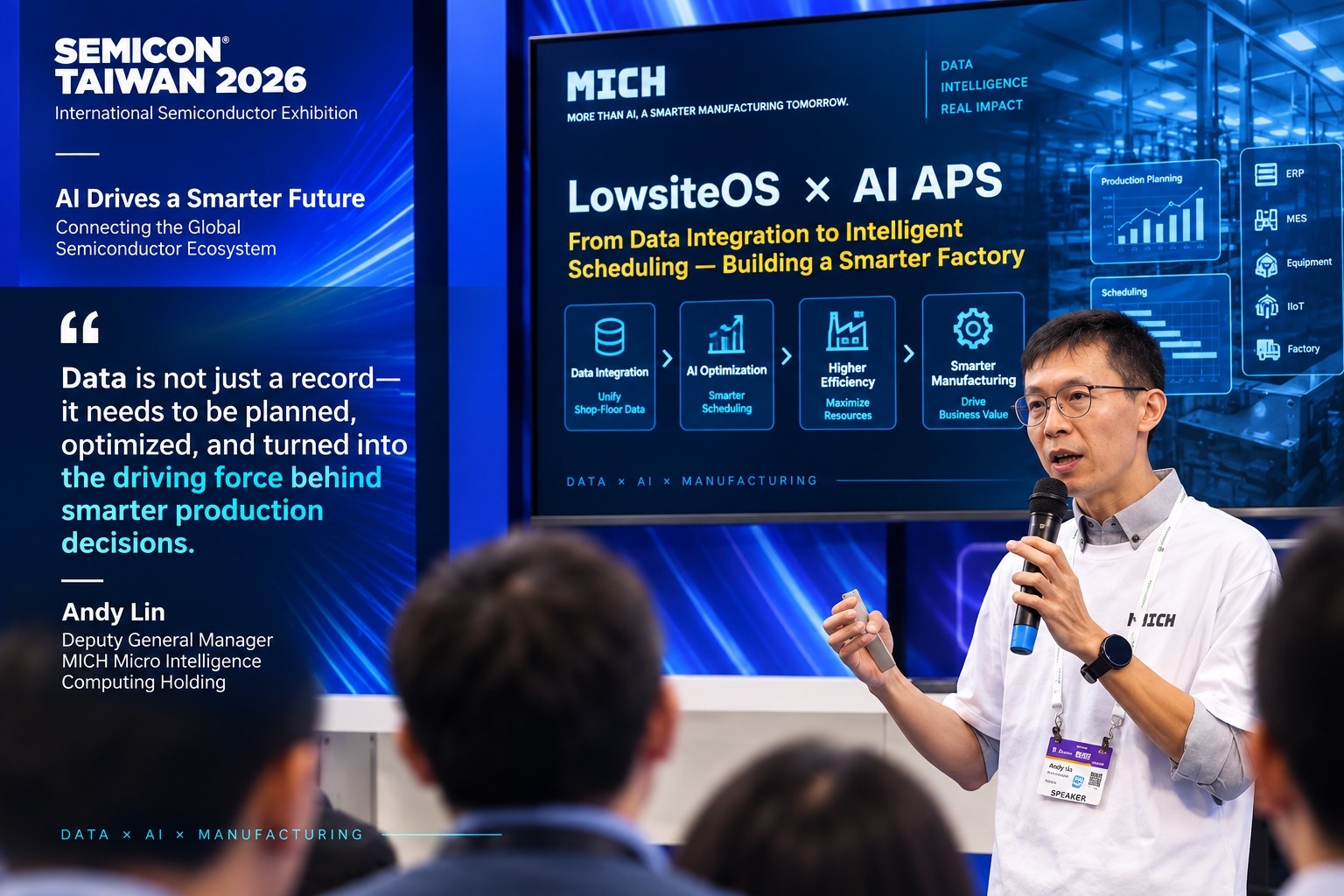
This is where LowsiteOS plays an important role in the enterprise AI architecture.
Existing ERP, MES, APS, WMS, and equipment systems do not need to be replaced simply because an enterprise wants to adopt AI. Through a common data layer, existing systems can be connected and their fragmented information progressively transformed into AI-ready data.
But connectivity is only the first step.
For Chang, AI also needs to understand what enterprise data actually means.
The same metric—whether yield, lead time, utilization, or another operational KPI—may be defined or calculated differently across departments. If the business meaning behind a table, column, or metric is not clearly defined, an AI model may successfully retrieve the data while still interpreting it incorrectly.
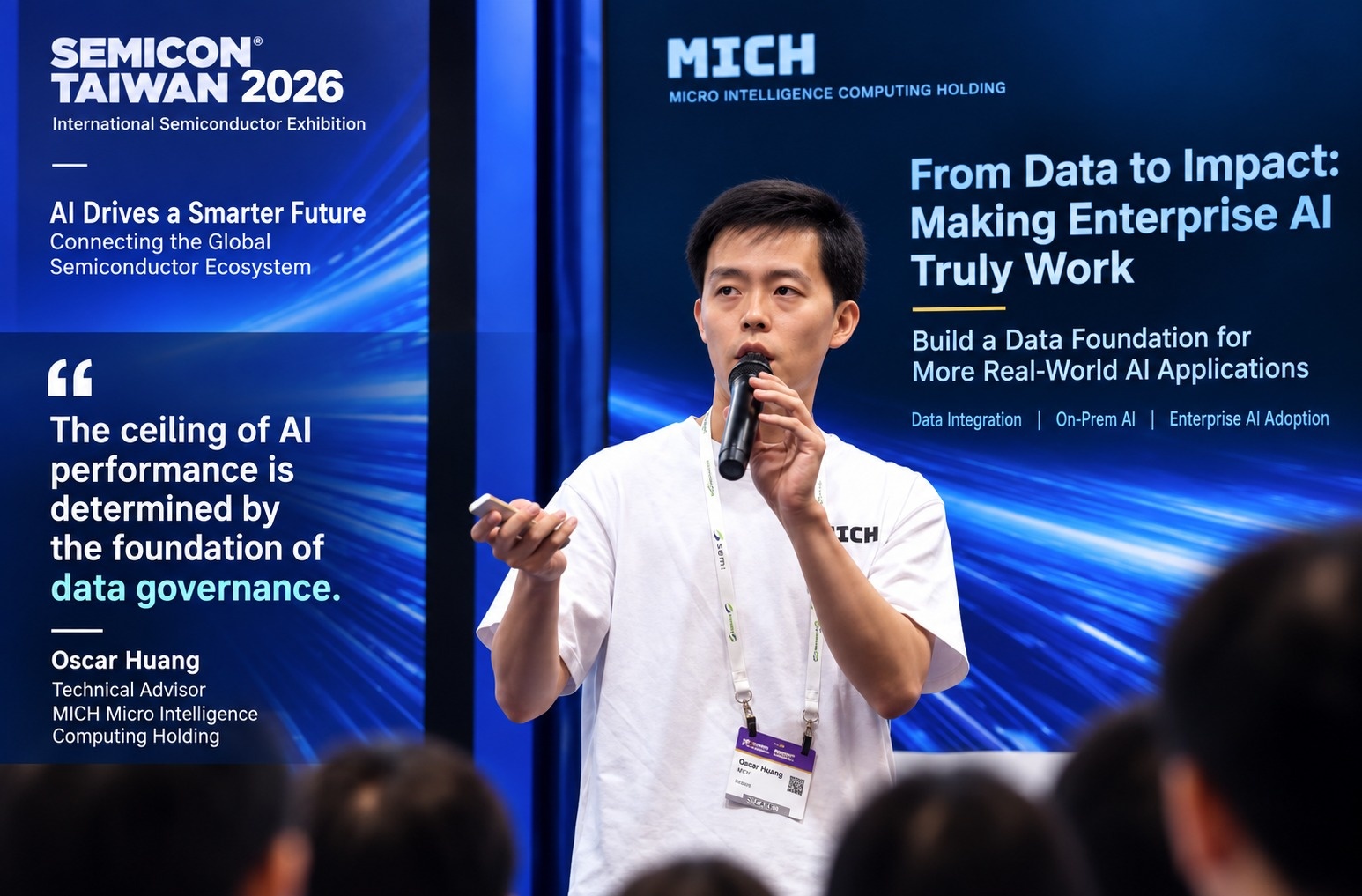
A true enterprise AI foundation therefore requires more than data integration. It must also incorporate semantics, permissions, and governance into a shared data layer.
Once this foundation is established, MES, APS, quality management, quotation systems, and AI agents can continue to scale on top of the same enterprise data architecture.
From MES Digitalization to Agent-Driven Decision Loops
Over the past decade, a major focus of manufacturing digital transformation has been turning factory operations into structured digital information.
MES tracks work orders, production progress, equipment, and process data. ERP manages orders, costs, and enterprise resources. APS addresses capacity, delivery commitments, and production scheduling.
AI agents introduce the possibility of connecting these previously separated systems into a new decision loop.
Take RFQ processing as an example. An agent can help structure customer requirements and historical information, then combine them with cost, capacity, scheduling, shop-floor, and quality data to bring cross-system information into the decision process more efficiently.
At this point, AI is no longer simply answering questions. It becomes an interface for cross-system analysis and decision support.
The value of an agent, however, is not determined by how many tools it can call. Its effectiveness ultimately depends on whether the enterprise has a reliable and consistent data foundation behind it.
The Next Competitive Advantage in Manufacturing AI Is Decision Speed
Chang has spent years working on algorithmic research. At its core, one of the fundamental goals of algorithms is to identify better solutions under limited time, resources, and constraints.
The same principle applies to smart manufacturing.
Every factory operates under a complex set of constraints: equipment capacity, materials, labor, delivery schedules, quality requirements, costs, and unexpected shop-floor disruptions.
Traditional enterprise systems are highly effective at recording this information. The next stage of AI is to help transform that information into Decision Intelligence.
The competitive question for manufacturers may therefore shift away from who adopts the latest model first.
Instead, the advantage will increasingly belong to those that can access the right data faster, understand operational changes sooner, and convert information into actionable decisions more effectively.
What Does the Enterprise Keep After Its First AI Agent?
This is also where Chang emphasizes the importance of creating a compounding effect from enterprise AI investments.
If the first AI project leaves behind only a standalone application, the second project may still need to reconnect the ERP, reinterpret the MES, and redefine data structures and permissions.
But if the first agent leaves behind reusable data sources, semantics, permissions, and transformation logic, the second agent can build directly on that foundation and focus only on what is genuinely new.
As the third, fifth, and eventually tenth AI application is deployed, the economics of enterprise AI begin to change.
The true competitive advantage is not how many AI projects an enterprise launches, but whether every completed project makes the next one easier to deploy.
From the digital foundation created by MES, ERP, and APS, to the AI-ready data layer established through LowsiteOS, and ultimately to AI agents operating across quoting, scheduling, production, quality, and business operations, manufacturing AI is evolving from isolated tools into a new decision architecture.
For a CTO whose career has moved from algorithmic research to real-world enterprise AI deployment, the ultimate measure of AI value comes back to one fundamental principle:
The goal is not to make AI do more. It is to help enterprises make better decisions.