From quality anomaly analysis and predictive maintenance to intelligent scheduling, production Q&A, and AI Agents that proactively support frontline decision-making, AI use cases in manufacturing are expanding rapidly.
Yet once AI enters the factory, the challenge often comes back to one fundamental question:
Where is the production data that AI needs to analyze?
The Value of MES: Helping AI Understand the Factory
Once a work order is issued from ERP and enters the factory floor, it moves across different machines, stations, operators, and processes.
Planned output, actual production, equipment downtime, quality issues, process parameters, and work-in-process status all generate different types of production information.
This is why MES (Manufacturing Execution System) has become increasingly important in the AI era.
ERP knows what the enterprise needs to produce. MES needs to know what is actually happening on the factory floor right now.
From work-order release and production execution to shop-floor reporting, process records, exception reporting, and production progress, MES does more than create digital records. It establishes a continuous digital event stream that reflects the real-time state of factory operations.
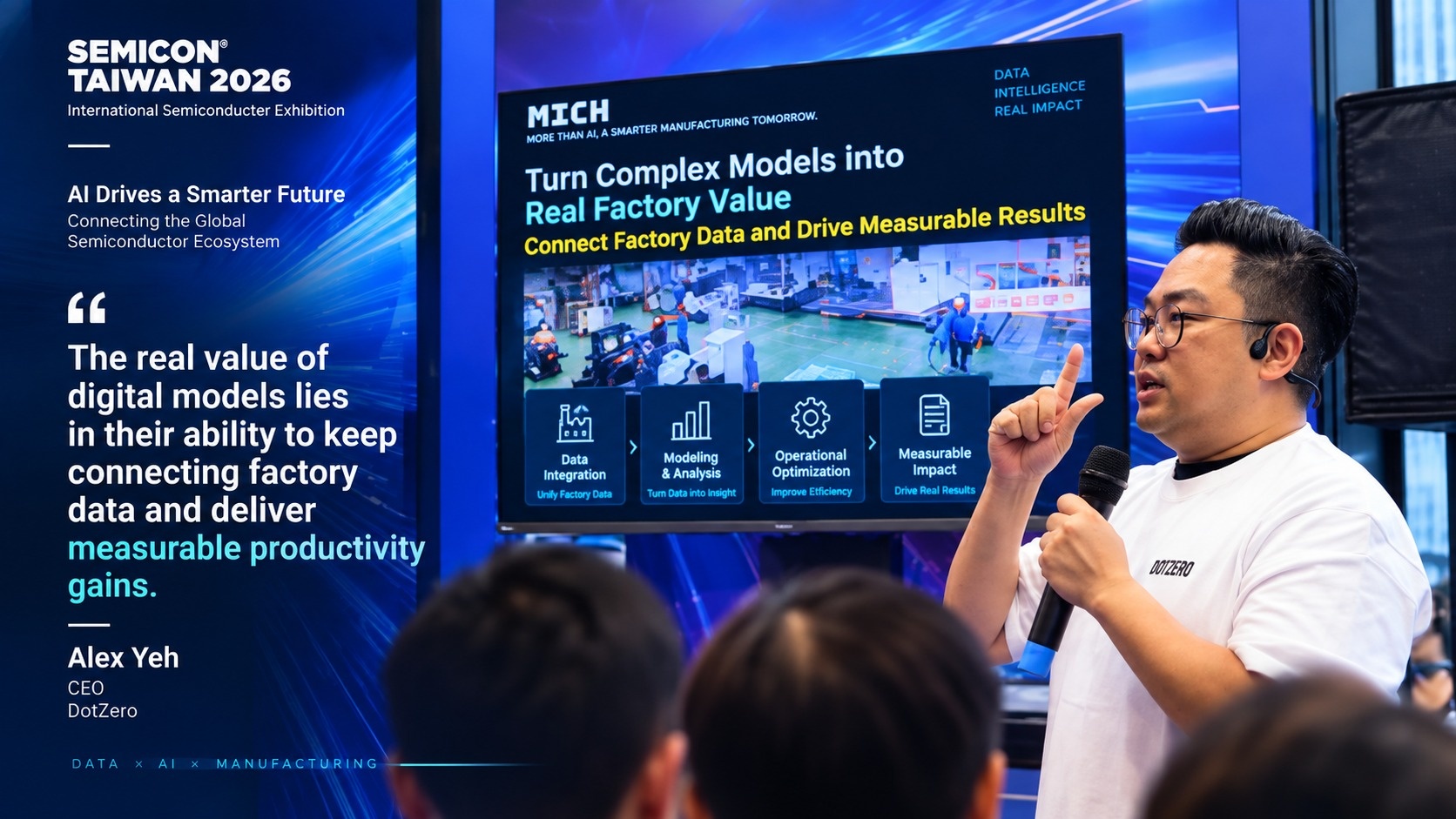
Alex Yeh, CEO of DotZero, has extensive experience in manufacturing digitalization and MES implementation. In his view, smart manufacturing must ultimately address the most practical business questions: Can it improve production efficiency? Can it reduce waste on the shop floor? And can it generate measurable operational value?
Digital transformation, therefore, does not necessarily have to begin with a massive system overhaul. Instead, manufacturers can start by building capabilities around the production scenarios that deliver the greatest value.
From Dashboards to AI: Context Is the Key
The first stage of the smart factory was largely about giving managers real-time visibility through dashboards—production output, equipment utilization, machine status, and work-order progress.
AI introduces the next stage, moving factory systems beyond Monitoring toward Analysis, Prediction, and eventually Action:
What happened → Why did it happen → What is likely to happen next → What should we do about it?
At this stage, simply knowing that “a machine was down for 20 minutes” is no longer enough.
AI also needs to understand which work order was running, which part number was being produced, which process step was involved, what the equipment and quality conditions were at the time, and how similar incidents were handled in the past.
In other words:
AI does not simply need more data. It needs data with manufacturing context.
MES is one of the most important sources for establishing that context.
MES Alone Is Not Enough: AI Problems Are Cross-System by Nature
Real manufacturing problems rarely exist within a single system.
When a manager asks, “Why did the yield on Production Line A drop today?”, the answer may require MES process records, ERP batch and part-number information, equipment sensor data, quality inspection results, SOPs, maintenance records, and the experience accumulated by engineers over time.
This creates a new challenge as manufacturers move from MES-driven digitalization to AI-driven intelligence.
ERP, MES, APS, WMS, and equipment systems were each designed for different purposes. But the questions an AI Agent needs to solve are inherently cross-system.
If every new AI application requires manufacturers to reconnect MES, ERP, equipment, and documents from scratch, enterprises will simply create another generation of AI data silos.
LowsiteOS × MES: Building an AI Data Layer on Top of Manufacturing Data
This is where LowsiteOS and MES come together.
LowsiteOS is not designed to replace MES. Instead, it extends the value of the manufacturing data already captured by MES by connecting it with ERP, APS, WMS, equipment systems, and enterprise knowledge—creating a shared data foundation that AI can use.
The architecture can be understood as:
Equipment / PLC / IoT → MES → LowsiteOS AI Data Layer → AI Agent → Shop-Floor Applications
ERP, APS, WMS, quality systems, and enterprise documents can also feed into the same AI Data Layer from different directions.
As a result, AI Agents no longer operate across a collection of isolated systems. Instead, they work within a data environment enriched with relationships, manufacturing semantics, and enterprise context.
MES Digitalizes the Shop Floor. LowsiteOS Makes Enterprise Data AI-Ready.
When the two are combined, the role of AI Agents begins to evolve.
When a work order falls behind schedule, AI can analyze production records together with equipment status to identify potential causes.
When equipment fails, AI can search maintenance histories and relevant SOPs for troubleshooting guidance.
When quality indicators deviate from expected ranges, AI can analyze relationships across processes, equipment conditions, and historical records to identify potential contributing factors.
AI therefore moves beyond simply reading MES data.
Instead, it can:
Understand information across systems and bring that intelligence back into the manufacturing scenarios managed by MES to support better decisions.
This is also a natural extension of the manufacturing digitalization approach emphasized by Alex Yeh in the AI era.
Enterprises do not need to replace their existing ERP, MES, or equipment infrastructure simply to adopt AI.
Instead, they can begin by digitalizing the manufacturing scenarios that create the greatest value, then progressively transform the data they have already accumulated into reusable AI assets.
MES turns shop-floor operations into data. LowsiteOS turns distributed enterprise data into context that AI can understand.
From MES and LowsiteOS to AI Agents, the complete journey becomes:
Shop-Floor Digitalization → Data Structuring → Cross-System Integration → AI Understanding → Decision Support → Shop-Floor Applications
Once this data chain is connected end to end, the next stage of smart manufacturing is no longer simply about seeing the factory.
It is about enabling AI to understand the factory, support decisions, and become an active part of manufacturing operations.